-
PRODUCTS & SERVICESOptimized cooling solutions for modern data centersProducts & ServicesOptimized cooling solutions for modern data centers
-
CAPABILITIESAdvancing liquid cooling technologiesCapabilitiesAdvancing liquid cooling technologies
-
TechnologiesLiquid Cooling InnovationTechnologiesLiquid Cooling Innovation
-
RESOURCESLatest News & InformationResourcesLatest News & Information
-
ABOUTOur history, leadership and ownershipAboutOur history, leadership and ownership
-
CONTACTFacility locations and global operational footprint






What Are the Top Types of RF Connector Adaptors?
Choosing the right RF connector adaptor can determine whether a signal remains clean, stable, and measurable. In practical testing, a poorly matched adaptor may create unexpected reflections, extra insertion loss, or a misleading measurement result. This is why engineers examine more than connector shape. They check impedance, operating frequency, shielding, durability, and the equipment’s interface before making a decision.
This guide explores the top types of Rf Connector Adaptors, including SMA, N-type, BNC, TNC, MCX, MMCX, and precision 2.92 mm options. Each design serves a different purpose. An SMA adaptor may suit compact laboratory equipment, while an N-type adaptor offers stronger outdoor performance. A BNC version provides fast bayonet coupling, which helps during repeated bench testing. However, convenience can hide limitations.
Small details matter.
A reliable selection process considers cable size, gender configuration, frequency range, and environmental exposure. It also reviews return loss, voltage standing wave ratio, and connector torque requirements. In my experience, technicians sometimes focus only on physical compatibility. That approach often fails when systems operate above several gigahertz. A connector may fit mechanically but perform poorly electrically. This article compares common adaptor types through practical applications, measurable specifications, and installation concerns. It also recognizes an uncomfortable truth: datasheets do not reveal every field problem. Real performance depends on assembly quality, calibration, contamination control, and repeated handling. Therefore, use these comparisons as guidance, not as a substitute for verified testing with suitable instruments.
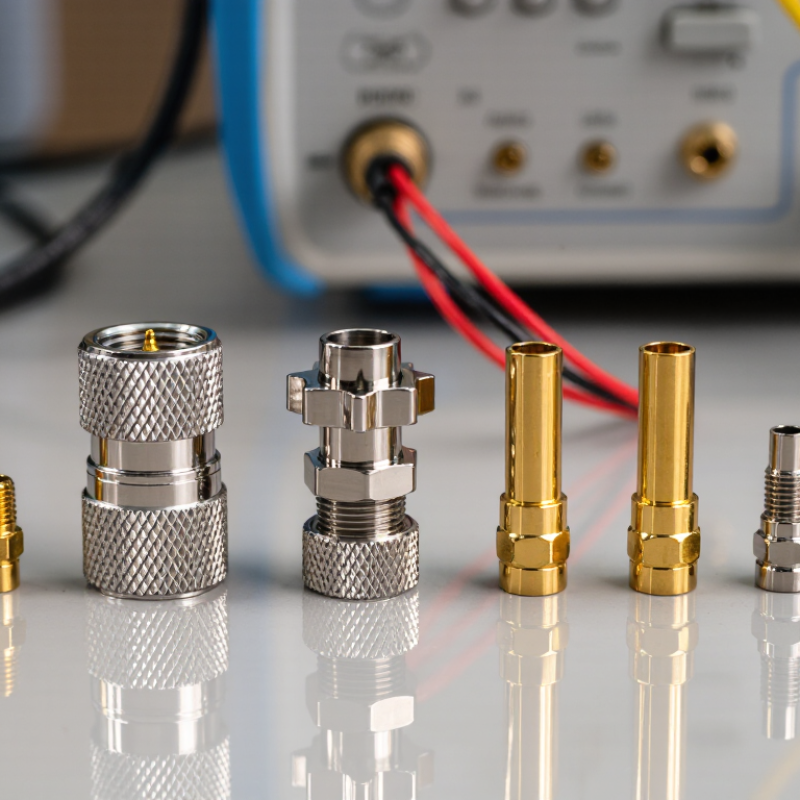
Table of Contents [Hide]
Understanding RF Connector Adaptors and Their Basic Functions
RF connector adaptors bridge different connector interfaces while preserving a usable radio-frequency path. They are common in antennas, test equipment, coaxial cables, and wireless installations. An adaptor may change the connector series, gender, or mounting angle. It should not be treated as a simple mechanical joiner.
SMA adaptors suit compact, high-frequency equipment and usually use a 50-ohm system. N-type adaptors provide a larger threaded connection for outdoor antennas and stronger mechanical protection.
BNC adaptors use a quick bayonet coupling, making them practical for instruments that need frequent connection changes. TNC adaptors add threading to a BNC-style interface, improving resistance to vibration.
UHF adaptors remain useful in some legacy and lower-frequency systems, although their impedance control is less consistent. These are common choices, not universal answers.
The key function is controlled signal transfer. Check impedance before installation. A 50-ohm adaptor in a 75-ohm video path can create reflections and measurable loss. Frequency range matters too. A connector may fit perfectly but perform poorly at higher frequencies.
I have seen technicians overlook cable diameter and bend radius. That mistake can stress the adaptor and loosen the connection. Small detail. Big consequence. Keep mating surfaces clean, tighten threaded parts correctly, and avoid forcing mismatched interfaces.
Weather-exposed connections also need suitable sealing. Even careful selection cannot remove every loss, because each extra adaptor adds another transition.