China Top 10 GPU Cooling Systems Manufacturers?

China has become a major production base for GPU Cooling Systems, serving gaming, workstation, data center, and industrial computing markets. This guide examines ten notable Chinese manufacturers and the capabilities behind their cooling solutions. It considers vapor chambers, heat pipes, cold plates, fans, liquid cooling loops, and complete thermal assemblies.

Performance depends on more than advertised heat dissipation. It depends on contact pressure, material quality, pump reliability, acoustic control, and long-term testing. A copper cold plate may look impressive, yet poor machining can reduce thermal contact. Small design details matter.

The evaluation focuses on manufacturing experience, engineering depth, quality systems, customization, and after-sales support. It also considers production scale, testing equipment, certifications, and evidence from real customer applications. Product samples, factory audits, and technical datasheets offer stronger proof than promotional claims. However, public information is not always complete. Some supplier capabilities require direct verification.

Readers should compare thermal resistance, operating temperature, noise levels, power consumption, and service life. Compatibility is equally important. A cooling module must fit the GPU package, board layout, enclosure, and intended workload. A data center solution faces different demands from a desktop graphics card.

This overview is not a permanent ranking. Market conditions, factory investments, and product quality can change. Use it as a practical starting point. Request current test reports. Confirm production capacity. Ask precise engineering questions. Reliable decisions need evidence, not attractive specifications alone.
China Top 10 GPU Cooling Systems Manufacturers?

GPU Cooling Systems: Definition, Functions, and Core Technologies

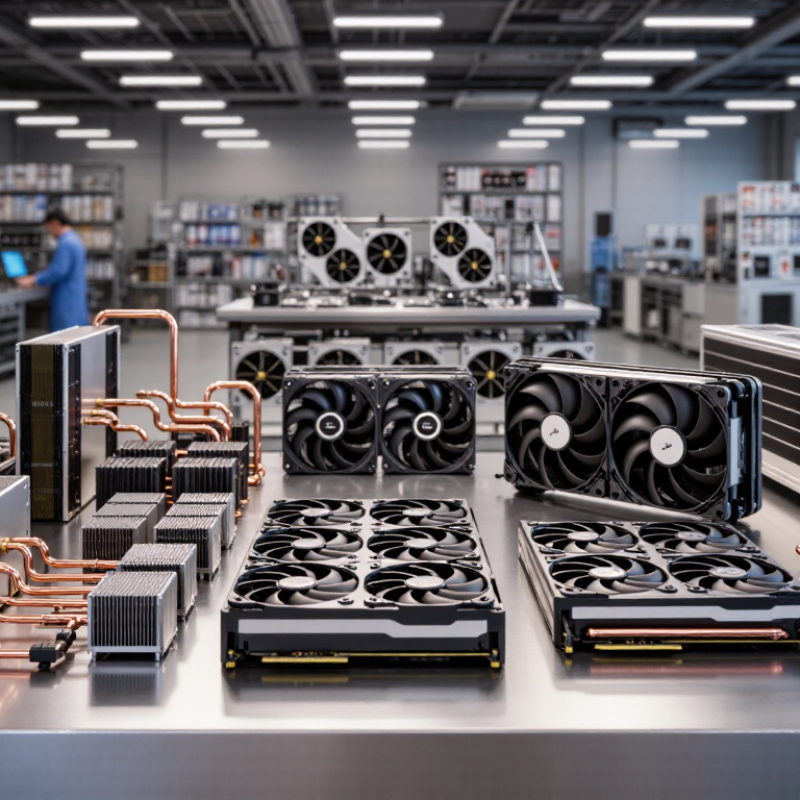
GPU cooling systems remove heat generated by graphics processors during rendering, simulation, and artificial intelligence workloads. They protect performance, stability, and component lifespan. A typical system combines a heatsink, thermal interface material, fans, and airflow channels. Advanced designs may use heat pipes, vapor chambers, or liquid cold plates.

The cooling path must move heat from the GPU die to the surrounding air efficiently. Thermal interface materials fill tiny surface gaps between the chip and cooler. Even a thin uneven layer can raise operating temperatures. Fans create airflow, while fin spacing controls heat dissipation and noise. Liquid systems transport heat through a coolant loop. Pumps, radiators, tubes, and leak-resistant seals become critical parts.

Real testing matters more than attractive specifications. Engineers measure temperatures, fan speed, acoustic output, and power changes under sustained workloads. Short benchmark tests can hide thermal throttling. A higher fan speed is not always better. It may improve cooling but create uncomfortable noise. This trade-off needs careful review. China’s GPU cooling manufacturers increasingly develop compact vapor chambers, high-pressure fans, and intelligent control systems for dense computing equipment. However, material quality and assembly consistency can vary between production batches. Independent thermal testing, reliability checks, and long-duration operation reveal weaknesses that product sheets may miss. Sensor placement also deserves attention. Poorly positioned sensors can report safe readings while hotspots develop nearby.

China’s GPU Cooling Industry: Product Types and Market Segments

China’s GPU cooling industry now serves several thermal design needs, from desktop graphics cards to dense data-center accelerators. Manufacturers commonly produce air coolers, vapor chambers, heat pipes, liquid cold plates, and immersion-cooling components. Each type targets a different heat density, noise limit, and maintenance plan.

Air cooling remains practical for gaming PCs, workstations, and entry-level servers. It usually combines aluminum fins, copper contact plates, and high-static-pressure fans. Vapor chambers and heat pipes support compact graphics cards with uneven heat distribution. Liquid cold plates fit AI servers and professional computing systems, where continuous workloads create intense thermal pressure. Immersion systems serve selected data centers, but deployment requires compatible fluids, sealed hardware, and careful facility planning.

Market segments are becoming more specialized. Consumer products prioritize price, acoustics, appearance, and simple installation. Enterprise buyers examine thermal resistance, pump reliability, service life, and rack-level power density. Industrial vision, simulation, and edge-computing systems often need compact cooling with stable performance in dusty or variable environments. Testing should include inlet temperature, sustained load, fan speed, vibration, and long-duration cycling.

A clean specification sheet can still mislead. Real performance depends on mounting pressure, thermal interface material, airflow layout, and firmware control. Some suppliers appear strong in prototypes but lack repeatable mass production. Buyers should request test methods, failure data, material certifications, and traceable quality records. The industry is capable, but validation remains essential.

China’s GPU Cooling Industry: Product Types and Market Segments

The chart compares representative thermal-load ranges supported by major GPU cooling product types. Passive and low-profile air cooling are commonly used in low-power embedded and compact systems, while tower air, blower, all-in-one liquid, and custom liquid cooling serve progressively higher-performance GPU applications. The ranges are engineering reference bands rather than company or brand sales data.

Criteria for Selecting China’s Top 10 GPU Cooling Manufacturers

China Top 10 GPU Cooling Systems Manufacturers?

Selecting China’s leading GPU cooling manufacturers requires measurable evidence, not attractive catalog claims. ASHRAE TC 9.9 recommends inlet temperatures of 18–27°C for many air-cooled data-center systems. A qualified supplier should provide thermal resistance, flow-rate, pressure-drop, and acoustic test results under comparable conditions. Test methods matter more than isolated peak performance.

The International Energy Agency reported that data centers used about 415 TWh of electricity globally in 2024. It expects demand to approach 945 TWh by 2030. This growth increases pressure on cooling efficiency. Buyers should examine cold-plate uniformity, pump reliability, coolant compatibility, leak detection, and service life. Independent laboratory testing is valuable. Factory testing alone may be insufficient.

Manufacturing depth also separates serious suppliers from capable imitators. Review machining tolerances, brazing or bonding quality, automated inspection, traceability, and annual production capacity. Ask for accelerated life-test records and failure-rate data. Compliance with relevant safety and environmental requirements should be documented clearly. A supplier’s engineering team should explain customization limits without exaggeration. No ranking stays perfectly stable. New thermal designs can outperform older factories quickly, while published efficiency figures may omit pump energy or installation losses. That detail deserves careful verification.

Profiles of China’s Top 10 GPU Cooling Systems Manufacturers

China Top 10 GPU Cooling Systems Manufacturers?

Profiles of China’s Top 10 GPU Cooling Systems Manufacturers

China’s leading GPU cooling manufacturers now serve data centers, workstations, and edge-computing projects. Their product profiles differ sharply. Several focus on copper cold plates with microchannels, while others develop vapor chambers, heat pipes, rear-door units, or immersion tanks. A smaller group integrates pumps, manifolds, sensors, and control software. This matters because GPU racks increasingly exceed 30 kW, making conventional air cooling less effective.

The International Energy Agency reported that data centers consumed about 460 TWh of electricity globally in 2022. It projects demand could exceed 1,000 TWh by 2026. Cooling efficiency is therefore an operating issue, not merely a hardware choice. Among China’s top ten manufacturers, the strongest candidates typically demonstrate controlled brazing, low-leakage testing, thermal cycling, and stable coolant compatibility. Some also provide computational fluid dynamics analysis before production. Useful evidence includes measured thermal resistance, pressure-drop curves, pump failure data, and third-party laboratory validation.

However, supplier claims still require careful review. A prototype may perform well on a test bench but struggle with dust, vibration, or uneven rack loading. I would request a 72-hour thermal soak test and inspect the contact surface under magnification. Small machining marks can become serious weaknesses. China’s manufacturing depth is impressive, but documentation quality remains uneven. The best profiles combine scalable production, responsive engineering support, and transparent test methods rather than relying on impressive specifications alone.

Technology, Capacity, Certifications, and Service Comparison

China’s top ten GPU cooling system manufacturers should be compared by technology, capacity, certifications, and service, not advertising claims. Air cooling remains practical for moderate GPU racks, while direct-to-chip liquid cooling supports higher heat density. The International Energy Agency reported that data centers consumed about 460 TWh globally in 2022. It expects demand to potentially exceed 1,000 TWh by 2026. This makes cooling efficiency a procurement issue, not a cosmetic upgrade.

Manufacturers with tested cold plates, leak detection, quick-disconnect fittings, and intelligent control deserve higher scores. Production capacity should include monthly output, pressure-testing records, spare-parts inventory, and verified delivery history. ISO 9001 supports process control, while ISO 14001 reflects environmental management. CE, RoHS, UL-related testing, and local safety approvals may also matter, depending on the destination market. Uptime Institute surveys repeatedly identify cooling failure and power disruption as major data-center risks. A certificate alone proves little.

Tips: Request a live factory audit. Ask for thermal test data at the intended GPU power level. Check coolant compatibility and maintenance intervals. Service quality is often underestimated. A serious supplier should offer remote monitoring, trained field engineers, emergency response targets, and clear warranty exclusions. Compare response times in writing, not during a sales call. Some capacity figures may describe total factory potential, rather than GPU cooling output. That distinction is easy to miss. I would also test a pilot rack before signing a large contract, because laboratory performance can change under dust, vibration, unstable water quality, and rushed installation.

China Top 10 GPU Cooling Systems Manufacturers? – Technology, Capacity, Certifications, and Service Comparison

Rank Anonymized Manufacturer Primary GPU Cooling Technology Typical Product Scope Indicative Annual Capacity Relevant Certifications and Compliance Thermal Performance Focus Customization Capability After-Sales and Engineering Service Best-Fit Applications
1 Manufacturer A Microchannel liquid cold plates and machined copper-water blocks Single-GPU plates, multi-GPU server assemblies, manifolds 100,000–300,000 units/year ISO 9001; RoHS; REACH; CE documentation available by project Low thermal resistance, uniform flow distribution, leak prevention High; CNC, vacuum brazing, surface treatment, custom ports DFM review, thermal simulation, prototype support, pressure testing AI servers, HPC clusters, data-center racks
2 Manufacturer B Skived-fin copper heat sinks with vapor chambers GPU heat sinks, vapor-chamber modules, hybrid air coolers 300,000–800,000 units/year ISO 9001; ISO 14001; RoHS; REACH High fin density, rapid heat spreading, low contact resistance High; fin geometry, vapor-chamber size, mounting interfaces Thermal testing, airflow validation, sample approval, batch inspection Workstations, edge servers, graphics appliances
3 Manufacturer C Cold-forged copper and aluminum heat sinks Extruded, stamped, bonded, and cold-forged GPU coolers 500,000–1,500,000 units/year ISO 9001; RoHS; REACH; material traceability Cost-efficient heat dissipation for medium-power devices Medium to high; tooling required for new geometries Tooling design, first-article inspection, dimensional reports Commercial GPUs, embedded systems, industrial computers
4 Manufacturer D Heat-pipe and vapor-chamber hybrid assemblies GPU modules, heat-pipe arrays, fin-stack assemblies 200,000–600,000 units/year ISO 9001; RoHS; REACH; CE support for finished equipment Passive cooling, heat spreading, noise reduction High; heat-pipe routing and fin-stack configuration CAD support, thermal mapping, reliability testing, replacement guidance Gaming systems, compact servers, industrial workstations
5 Manufacturer E Direct-to-chip liquid cooling and rack manifolds Cold plates, quick disconnects, manifolds, CDU subassemblies 30,000–100,000 cooling assemblies/year ISO 9001; ISO 14001; RoHS; REACH; UL-related component documentation High heat-load removal and rack-level liquid distribution High; flow paths, fittings, materials, monitoring interfaces Site assessment, commissioning support, leak testing, maintenance training High-density AI and HPC data centers
6 Manufacturer F Aluminum cold plates with friction-stir-welded channels Large-format cold plates, power electronics plates, manifolds 50,000–150,000 units/year ISO 9001; ISO 14001; RoHS; REACH Large-area cooling, structural rigidity, controlled pressure drop High; channel layout, plate thickness, port orientation Flow and pressure testing, welding inspection, engineering change control Server trays, telecom equipment, industrial GPU platforms
7 Manufacturer G Vapor chambers and ultra-thin copper heat spreaders Thin GPU coolers, heat spreaders, compact thermal modules 250,000–700,000 units/year ISO 9001; RoHS; REACH; supplier material declarations Fast in-plane heat spreading in restricted Z-height designs High; thickness, wick structure, shape, hole pattern Prototype builds, thermal cycling, flatness measurement, failure analysis Compact servers, edge AI devices, embedded GPU products
8 Manufacturer H Integrated fan, heat-pipe, and fin-stack GPU coolers Complete air-cooling modules, fan shrouds, mounting kits 400,000–1,000,000 units/year ISO 9001; RoHS; REACH; CE and EMC documentation for assemblies Balanced thermal performance, acoustics, and system integration Medium to high; fan curves, shroud design, mounting hardware Acoustic testing, airflow testing, assembly instructions, warranty handling Consumer graphics cards, gaming PCs, professional desktops
9 Manufacturer I Copper-water cold plates with brazed internal channels CPU/GPU cold plates, power-module coolers, liquid loops 80,000–250,000 units/year ISO 9001; ISO 14001; RoHS; REACH; process traceability High heat flux, reliable brazed joints, moderate flow resistance High; channel patterns, seals, fittings, surface finishes Leak and burst testing, sample validation, technical documentation Industrial servers, test equipment, energy electronics
10 Manufacturer J Custom thermal modules combining liquid and passive cooling Prototype-to-production GPU cooling systems and thermal subassemblies 20,000–80,000 units/year ISO 9001; RoHS; REACH; customer-specific compliance packages Application-specific optimization for thermal, acoustic, and space limits Very high; rapid prototyping, mixed materials, custom interfaces NPI support, thermal design review, pilot production, on-site troubleshooting Specialized AI appliances, robotics, defense and industrial computing
Comparison note: Capacity figures are indicative production bands for comparable cooling assemblies rather than verified company-specific disclosures. Certification coverage, test reports, and regulatory documentation should be confirmed for the exact factory, product, and purchase order.