-
PRODUCTS & SERVICESOptimized cooling solutions for modern data centersProducts & ServicesOptimized cooling solutions for modern data centers
-
CAPABILITIESAdvancing liquid cooling technologiesCapabilitiesAdvancing liquid cooling technologies
-
TechnologiesLiquid Cooling InnovationTechnologiesLiquid Cooling Innovation
-
RESOURCESLatest News & InformationResourcesLatest News & Information
-
ABOUTOur history, leadership and ownershipAboutOur history, leadership and ownership
-
CONTACTFacility locations and global operational footprint


How to Choose a Fingerprint Scanner in 2026?
Choosing a Fingerprint Scanner in 2026 means looking beyond the sensor’s advertised speed. A busy reception desk, a dusty warehouse, and a shared tablet create very different conditions. Start with the setting. The right device should capture reliable fingerprints there, not only in a clean demonstration.
Market growth adds urgency, but it needs context. Grand View Research valued the global biometric systems market at approximately USD 42.9 billion in 2023 and projected a 20.4% compound annual growth rate from 2024 to 2030. That figure covers multiple biometric technologies, not fingerprint scanners alone. Still, it signals expanding investment—and more products competing for attention. Specs can blur together.
Security deserves equal weight. NIST’s Digital Identity Guidelines, SP 800-63B-4, treat biometrics as part of multi-factor authentication with a physical authenticator, rather than a stand-alone secret. For buyers, that makes integration, enrollment controls, presentation-attack detection, and data handling important evaluation points. Check how a Fingerprint Scanner performs with dry skin, worn fingerprints, gloves, and repeated daily use. Ask for independent test results, not just vendor claims. A clean lab test can flatter a device. Real-world performance may disappoint, and no single rating captures every user group. This guide compares the practical trade-offs behind sensor type, accuracy, speed, durability, compatibility, and total cost, helping you choose with evidence—and with a little healthy skepticism.
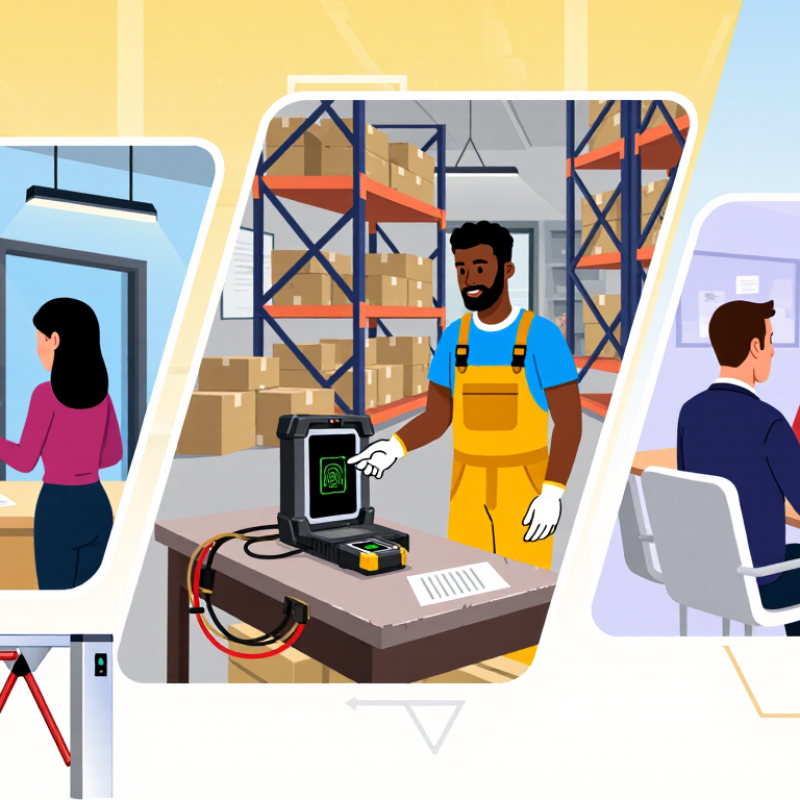
Table of Contents [Hide]
What a Fingerprint Scanner Does and Where It Is Used
A fingerprint scanner captures ridge patterns from a finger and converts them into a digital template. During verification, it compares a new scan with an enrolled template to check whether they match. Identification is broader: the system searches a collection of templates for a possible match. The distinction matters. A phone usually checks one enrolled user, while a workplace access terminal may compare against many authorized people.
Scanners appear in phones, building entry systems, attendance terminals, and some payment workflows. The sensor may be optical, capacitive, or ultrasonic; each handles moisture, pressure, and surface detail differently. NIST’s Special Publication 800-63B sets a useful benchmark for digital identity systems: biometric comparison should achieve a false match rate of 1 in 1,000 or better, and biometrics should be paired with a physical authenticator. That is a technical threshold, not a promise that every real-world scan will work. Cold fingers, worn ridges, dust, or hurried placement can still cause failed reads. In practice, test the scanner with the people and conditions it will actually serve. A clean lab result can be misleading.
How to Choose a Fingerprint Scanner in 2026? — What a Fingerprint Scanner Does and Where It Is Used
| Decision Factor | What the Scanner Does | Common Options | Typical Uses | What to Check Before Choosing |
|---|---|---|---|---|
| Capture technology | Records the fingerprint’s ridge-and-valley pattern and converts it into data for enrollment or comparison. | Optical sensors photograph the fingertip; capacitive sensors measure electrical differences; ultrasonic sensors use sound waves to map surface detail. | Optical: access-control terminals and enrollment stations. Capacitive: many compact devices. Ultrasonic: applications that need sensing through certain thin surface materials. | Match the sensor to the environment, device design, expected usage, and required image quality. No technology is automatically best for every application. |
| Verification or identification | Verification compares a presented finger with a claimed identity. Identification searches a fingerprint against a stored set of enrolled records. | One-to-one (1:1) matching; one-to-many (1:N) searching. | 1:1: device unlock, staff entry, and account verification. 1:N: identity searches in systems designed for larger record collections. | Confirm which matching mode the complete system supports. Search speed and accuracy depend on the sensor, software, database size, and operating conditions. |
| Image area and detail | Captures enough fingerprint area and ridge detail for the system to extract usable features. | Compact touch sensors; larger-area sensors; rolled-print capture devices for applications that require a broader impression. | Compact sensors suit personal devices and small terminals. Larger capture areas can help with supervised enrollment or formal fingerprint collection. | Check the active capture area, image resolution, supported finger-placement method, and whether the system meets the applicable agency or project requirements. |
| Matching performance | Compares extracted fingerprint features and returns a match score or decision. | Performance is typically described using measures such as false match rate (FMR) and false non-match rate (FNMR). | Relevant to all applications, especially access control, identity checks, and high-volume enrollment. | Request test results for the intended operating conditions and decision threshold. A lower false-match setting can increase the chance that a genuine user is rejected; published figures are not directly comparable unless test methods align. |
| Liveness and presentation-attack checks | May assess whether a presented sample appears to come from a live finger rather than a replica or other presentation. | Methods vary by sensor and system; some use additional signals or software checks. | Access points, identity verification, and other situations where spoofing is a concern. | Ask what attacks were tested and how the system was evaluated. Liveness checks can reduce some risks but do not guarantee that every attack will be detected. |
| Operating environment | Captures fingerprints under the conditions present at the point of use. | Enclosed or exposed sensors; fixed terminals; portable or handheld readers. | Indoor doors, outdoor gates, mobile field work, manufacturing sites, and public-facing kiosks. | Check temperature and moisture limits, dust or water protection, cleaning requirements, lighting sensitivity where relevant, and expected wear. Dry, wet, dirty, or damaged fingers may affect capture. |
| Integration and connectivity | Transfers fingerprint data or match results to a host device or identity-management system. | USB, embedded interfaces, or network-connected terminals, depending on the product design. | Workstations, door controllers, time-and-attendance systems, and managed identity platforms. | Confirm operating-system support, drivers or SDK availability, supported data formats, enrollment workflow, and compatibility with the existing system. |
| Privacy and data handling | Systems may store fingerprint images, derived templates, or both, depending on their design. | Local device storage; protected central storage; on-device comparison with limited data transfer. | Any deployment that collects, compares, or retains biometric information. | Find out what is stored, where it is stored, who can access it, how it is protected and deleted, and what consent, notice, retention, or legal requirements apply in the deployment location. |
| Accessibility and fallback | Provides one way to recognize a user, but not every person can reliably present a usable fingerprint. | Alternative credentials may include a card, PIN, staffed review, or another approved method. | Workplaces, public services, shared facilities, and systems with diverse users. | Plan an accessible alternative for users with worn, injured, or difficult-to-capture fingers, and define a secure recovery process for failed enrollment or repeated rejection. |
| Deployment and maintenance | Needs correct enrollment, routine operation, and upkeep to maintain consistent capture quality. | Self-service enrollment; supervised enrollment; scheduled cleaning and inspection. | Small installations as well as multi-site access or identity programs. | Estimate enrollment time, user throughput, cleaning frequency, support needs, replacement process, and total operating cost—not just the scanner purchase price. |
Practical note: A fingerprint scanner captures biometric information; the surrounding system handles enrollment, matching, access decisions, and data protection. Evaluate the complete system against the intended use, local requirements, and a representative user test.