-
PRODUCTS & SERVICESOptimized cooling solutions for modern data centersProducts & ServicesOptimized cooling solutions for modern data centers
-
CAPABILITIESAdvancing liquid cooling technologiesCapabilitiesAdvancing liquid cooling technologies
-
TechnologiesLiquid Cooling InnovationTechnologiesLiquid Cooling Innovation
-
RESOURCESLatest News & InformationResourcesLatest News & Information
-
ABOUTOur history, leadership and ownershipAboutOur history, leadership and ownership
-
CONTACTFacility locations and global operational footprint




10 Best RO Filtration Systems for Commercial Use
A commercial reverse osmosis purchase is not just a search for the highest gallon-per-day rating. It is a decision about feed-water quality, peak demand, operating hours, and the cost of rejected water. A Ro Filtration System that performs well in a brochure may struggle when incoming water changes or several production lines run at once. Details matter. Think of the shift supervisor checking a pressure gauge, the prefilters waiting for replacement, and the storage tank nearing empty before lunch.
For a useful technical lens, this guide draws on membrane engineer Dr. Mark Wilf’s published work on membrane systems. The following is a paraphrase, not a verbatim quotation: “Match membrane design to feed-water conditions and operating needs, not headline capacity.” That principle helps frame the ten systems compared here. Buyers should examine pretreatment, rated output, recovery, monitoring, service access, and replacement-part availability. Numbers need context. A stated capacity may assume particular water temperature and pressure, conditions a real facility may not maintain.
The strongest choice is rarely the biggest or cheapest unit. It is the system that reliably meets demand while fitting the site’s water profile, staff, and maintenance plan. Some comparisons will remain imperfect; manufacturers do not always report performance under identical conditions. Treat the rankings as a shortlist, then confirm specifications with a qualified water-treatment professional and site-specific water testing. A careful check now can prevent a costly mismatch later.
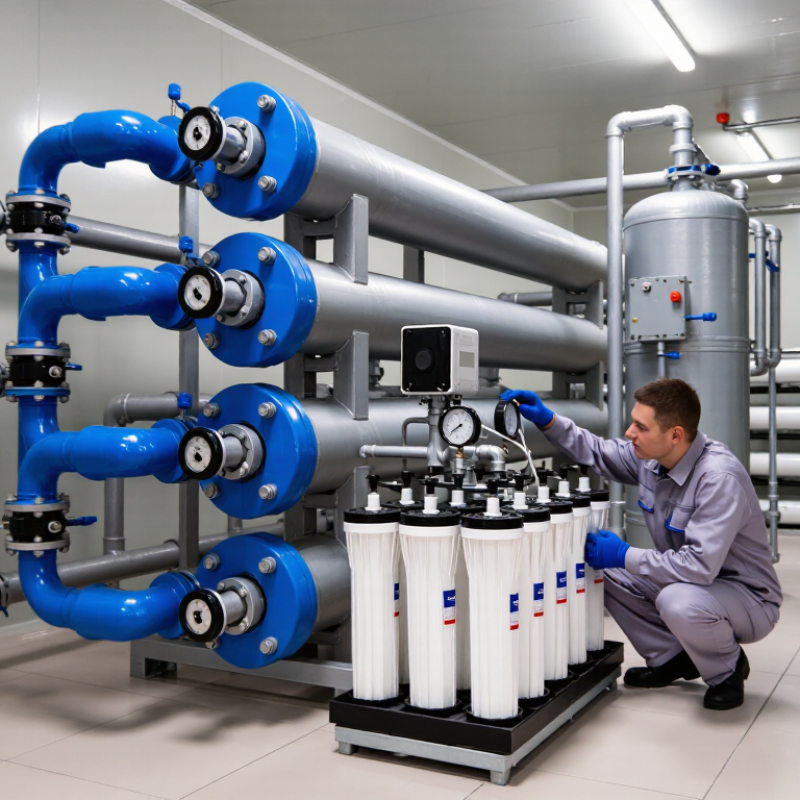
Table of Contents [Hide]
How Commercial Reverse Osmosis Filtration Systems Work
Commercial reverse osmosis (RO) systems reduce dissolved salts by pushing prefiltered water through a semipermeable membrane. Feed water passes through sediment and, when needed, carbon pretreatment before a high-pressure pump sends it into membrane vessels. Pretreatment matters. Fine grit can foul membranes, while chlorine can damage some membrane materials. The right setup depends on a water analysis and the membrane’s operating limits.
At the membrane surface, water passes through while much of the dissolved mineral content remains in a concentrated reject stream. Two outlets. Permeate flows to storage or process equipment; concentrate is discharged or managed according to site requirements. Pressure, temperature, and feed quality all affect output. Operators commonly track conductivity, pressure changes, and flow rates. A sudden shift is a warning, not a diagnosis.
Controls may flush membranes, log alarms, or adjust operation, but automation cannot replace inspection. Staff should check filters, connections, pump noise, and storage-tank sanitation. A clean-looking system can still have a fouled membrane. RO is not a complete maintenance plan. I may be overemphasizing the readings, but they often reveal trouble before production noticeably drops.
10 Best RO Filtration Systems for Commercial Use – How Commercial Reverse Osmosis Filtration Systems Work
Reverse osmosis (RO) uses pressure to push feed water through a semipermeable membrane. The membrane reduces dissolved salts and many other contaminants, producing permeate and a concentrated reject stream. The configurations below represent common commercial system types, not ranked or branded products.
| Commercial RO System Type | Typical Permeate Capacity | Typical Feed Water | Indicative Recovery | Common Pretreatment | Typical Uses | How It Fits the Application |
|---|---|---|---|---|---|---|
| Compact light-commercial RO | 250–1,000 gallons per day (GPD) | Municipal or low-to-moderate salinity brackish water | About 50–70% | Sediment filtration; carbon treatment when chlorine is present | Small cafés, clinics, and low-volume food-service operations | A compact arrangement suited to modest demand and limited installation space. |
| Restaurant and hospitality RO | 500–5,000 GPD | Municipal water or suitably pretreated well water | About 50–75% | Sediment filtration, dechlorination where needed, and scale control based on water analysis | Restaurants, hotels, beverage stations, and commercial kitchens | Provides treated water for multiple points of use; storage tanks can help meet short demand peaks. |
| Office and campus RO | 2,000–20,000 GPD | Municipal or brackish groundwater | About 50–75% | Particle filtration, chlorine removal if required, and antiscalant or softening when indicated | Large offices, schools, and institutional drinking-water systems | Centralized treatment can supply several users or downstream distribution points. |
| Boiler-makeup RO | 1,000–50,000 GPD | Municipal or well water, selected for the boiler’s feed-water requirements | About 50–75% | Filtration and scale-control pretreatment; softening may be used depending on feed chemistry | Commercial and industrial boiler makeup | Reduces dissolved solids entering the makeup-water treatment train; additional polishing may be needed for the boiler. |
| Food and beverage process-water RO | 2,000–50,000 GPD | Municipal or suitably treated groundwater | About 50–75% | Sanitary-compatible filtration and dechlorination as needed; pretreatment selected from water analysis | Food processing, beverage production, and ingredient-water preparation | Can provide a consistent treated-water supply; hygienic design and sanitation procedures matter. |
| Brackish-water RO for higher dissolved-solids feeds | 1,000–50,000 GPD | Brackish groundwater or other saline inland sources | Often about 50–75%; feed chemistry can require lower recovery | Cartridge or media filtration, scale control, and iron or manganese removal when present | Facilities using wells with elevated dissolved salts | Membrane selection and operating pressure are matched to feed salinity and target permeate quality. |
| High-recovery brackish-water RO | 1,000–50,000 GPD | Relatively consistent brackish feed suitable for staged concentration | Approximately 65–80% in suitable designs; not appropriate for every feed | Thorough filtration and chemistry-based scale control; feed-water testing is essential | Sites seeking to reduce reject-water volume where feed quality permits | Staging or specialized concentrate management can raise recovery, but scaling risk and concentrate disposal must be assessed. |
| Single-pass seawater RO | 1,000–50,000 GPD | Seawater | Generally about 35–50% | Fine filtration, often including ultrafiltration or equivalent pretreatment, plus seawater-compatible materials | Coastal commercial facilities and marine-related operations | Uses higher operating pressure than brackish-water RO because seawater has substantially greater salinity. |
| Containerized or modular seawater RO | 10,000–250,000 GPD | Seawater or high-salinity source water | Generally about 35–50% | Intake screening and fine filtration; pretreatment depends on turbidity and biological loading | Remote sites, coastal facilities, and temporary or modular water-supply projects | Integrates major treatment components in a modular layout; intake quality and reject disposal remain site-specific considerations. |
| Two-pass RO or RO with EDI polishing | 1,000–100,000 GPD, depending on configuration | First-pass RO permeate or other suitable pretreated feed | Overall recovery varies; often roughly 45–70% for two-pass arrangements | First-pass RO pretreatment; additional protection and monitoring for the second pass or EDI stage | Laboratories, pharmaceutical support systems, and applications requiring higher-purity water | A second RO pass or electrodeionization (EDI) can further reduce ionic content; final quality depends on the complete treatment train. |
Capacity and recovery figures are indicative design ranges, not guaranteed specifications. Actual performance depends on feed-water chemistry, temperature, pressure, membrane selection, fouling control, and operating conditions. Confirm design requirements with a qualified water-treatment professional using a current feed-water analysis.