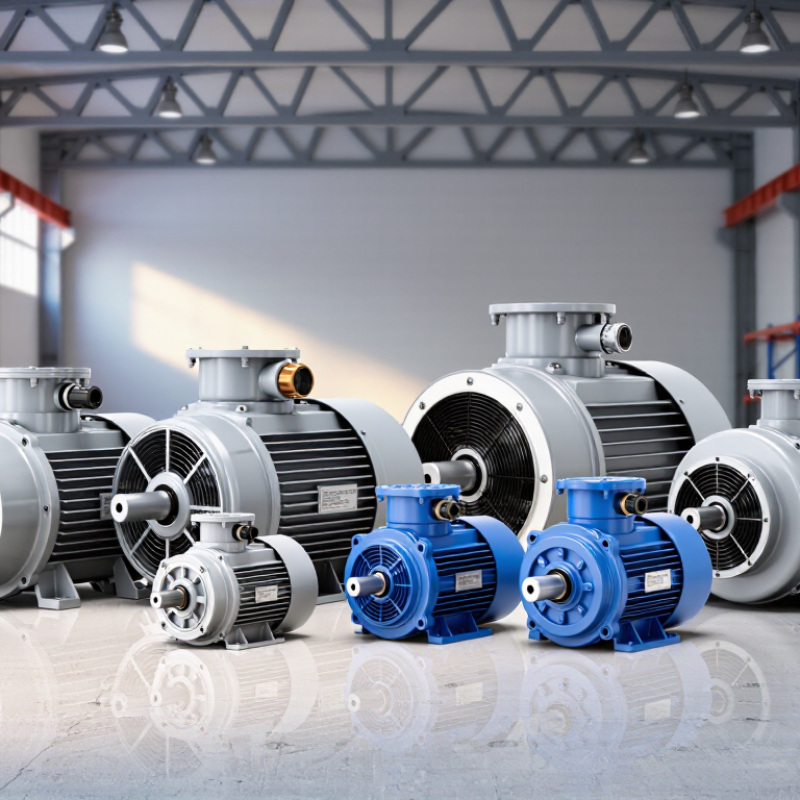
| Motor Configuration | Motor technology | Permanent-magnet synchronous motor (PMSM) or three-phase induction motor; confirm whether the motor is integrated with the fan controller. | IEC 60034-1GB/T 755 | Motor nameplate photo, technical datasheet, wiring diagram, and controller compatibility statement. | Choose a configuration that matches the fan diameter, operating hours, control method, and local electrical supply. | High |
| Electrical Rating | Rated voltage and frequency | Common international supplies include 220–240 V / 50 Hz, 380–415 V / 50 Hz, and 440–480 V / 60 Hz. Single-phase and three-phase options must be specified separately. | IEC 60034-1IEC 60038 | Rated-voltage range, frequency range, phase configuration, rated current, and terminal connection diagram. | Reject any quotation that does not state voltage, frequency, phase, and allowable voltage tolerance. | High |
| Power Selection | Rated output power | Typical HVLS fan motor selections may fall approximately between 0.75 kW and 5.5 kW, depending on fan diameter, blade design, speed, airflow target, and installation height. | Manufacturer sizing calculation; performance data should be measured on the complete fan system. | Motor power curve, fan selection chart, airflow data, torque requirement, and operating-point calculation. | Do not select by motor kW alone; verify airflow, static pressure, speed range, and energy use for the complete fan. | High |
| Efficiency | Motor efficiency class | For line-operated motors, request the declared efficiency class. IE3, IE4, or IE5 claims must be supported by a test report and the applicable motor type and rating. | IEC 60034-30-1IEC 60034-2-1 | Efficiency at 50%, 75%, and 100% load; test method; rated speed; power factor; and efficiency-class declaration. | Compare efficiency at the actual operating point, not only the maximum nameplate efficiency. | High |
| Speed Control | Control range and operating mode | Common speed-control methods include variable-frequency drive (VFD), integrated inverter control, or dedicated electronic commutation. Confirm the minimum stable speed and ramp settings. | IEC 61800-5-2IEC 61800-3 | Controller datasheet, speed-to-airflow curve, acceleration/deceleration settings, fault codes, and control-interface description. | Require stable operation at the lowest intended speed without overheating, vibration, or repeated fault trips. | High |
| Protection | Ingress protection rating | IP55 is a common baseline for protected indoor industrial environments. IP65 or higher may be appropriate for dustier or washdown-prone areas, subject to the complete assembly design. | IEC 60034-5IEC 60529 | IP test report, test sample description, shaft-seal information, and confirmation that the rating applies to the supplied motor assembly. | Match the IP rating to dust, moisture, cleaning chemicals, and installation location; do not rely on a marketing label alone. | High |
| Thermal Performance | Insulation system and temperature rise | Class F insulation is widely used for industrial motors; a Class H system may provide additional thermal margin. The declared temperature rise must be linked to the rated duty. | IEC 60034-1IEC 60085 | Insulation-class declaration, temperature-rise test, thermal protector specification, and permissible ambient-temperature range. | Require thermal protection when the fan may operate continuously, at low speed, or in ambient temperatures above 40°C. | High |
| Duty and Environment | Operating duty, ambient temperature, and altitude | Continuous-duty operation is commonly designated S1. A standard reference condition is 40°C ambient temperature and altitude up to 1,000 m; derating may be needed beyond these limits. | IEC 60034-1 | Duty rating, ambient-temperature range, altitude derating chart, humidity limits, and installation-environment restrictions. | Obtain written derating data for high-altitude sites, hot warehouses, coastal locations, or unconditioned buildings. | High |
| Mechanical Fit | Mounting, shaft, bearings, and dimensions | Verify flange or bracket arrangement, shaft diameter, shaft extension, keyway, bolt pattern, total weight, and center of gravity against the fan structure. | IEC 60072-1IEC 60034-7 | Dimensioned mechanical drawing, 3D file if available, bearing model or specification, shaft-load limits, and balancing record. | Approve only after the motor drawing is checked against the fan hub, gearbox or direct-drive interface, and suspension structure. | High |
| Noise and Vibration | Noise level and vibration severity | Request noise data in dB(A) and vibration data at the rated operating point. Values depend on fan blades, speed, mounting, room acoustics, and measurement distance. | ISO 3744ISO 20816-1 | Factory noise and vibration test report, measurement position, speed, load, test environment, and acceptance limit. | Compare products using the same test conditions; an isolated motor test cannot represent the noise of the complete HVLS fan. | Medium |
| Safety and Compliance | Electrical safety and market access | Required approvals vary by destination. The buyer should identify applicable low-voltage, EMC, machinery, workplace-safety, and product-marking requirements before production. | IEC 60204-1IEC 61000 seriesLocal regulations | Declaration of conformity, EMC results, electrical safety test report, risk assessment, user manual, and label artwork. | Never treat a generic certificate as proof of compliance for the exact motor, controller, voltage, and destination market. | High |
| Factory Testing | Routine motor tests | At minimum, request winding resistance, insulation resistance, dielectric withstand, no-load current, rotation direction, and functional run tests for each production batch. | IEC 60034-1IEC 60034-2-1 | Signed routine-test record containing serial or batch number, measured values, test date, and tester identification. | Make release of the shipment conditional on receiving test records linked to the supplied batch. | High |
| Sample Validation | Type and endurance testing | For new designs, validate thermal stability, continuous operation, start-stop cycles, speed-control response, vibration, and abnormal-condition protection. | Agreed qualification protocol based on the declared duty and application environment. | Type-test report, endurance log, failure history, corrective-action record, and sample identification. | Use a production-equivalent sample; prototype results should not automatically be accepted for mass production. | High |
| Quality Control | Traceability and change management | Each motor should be traceable by serial number or batch number. Material, winding, bearing, controller, and firmware changes should require documented approval. | Buyer-supplier quality agreement; ISO 9001 certification may support but does not replace product inspection. | Incoming-material records, process inspection plan, final inspection report, change-notification procedure, and nonconformance report. | Define which components are critical and require advance notice before substitution. | High |
| Warranty | Coverage period and remedy | A 12–24 month commercial warranty from shipment or commissioning is a common negotiation range; the exact start date and remedy must be written into the contract. | Commercial contract; statutory consumer or product-liability rules may also apply. | Warranty certificate, exclusions, response time, replacement-part policy, labor responsibility, and freight responsibility. | Prefer a warranty tied to commissioning or delivery with a clearly defined long-stop date and failure-response timeline. | High |
| Warranty Conditions | Exclusions and evidence requirements | Typical exclusions may include incorrect voltage, improper installation, unauthorized modification, blocked ventilation, corrosion beyond the declared environment, and misuse. | Contract terms and installation manual. | Installation checklist, commissioning report, maintenance log, photos, fault codes, and return-material authorization process. | Reject vague exclusions; specify who determines root cause and how disputed failures are independently reviewed. | High |
| Spare Parts | Availability and recommended stock | Plan for bearings, fans, sensors, controllers, cables, fuses, and mounting hardware. Stock quantity depends on fleet size, lead time, and criticality. | Application-specific maintenance plan. | Parts list, part numbers, interchangeability statement, shelf life, storage requirements, and spare-parts price validity. | For remote sites, buy critical spares together with the initial order rather than waiting for the first failure. | Medium |
| Packaging | Export protection and package data | Use moisture-resistant protection, immobilization against shaft impact, shock protection, and clear lifting points. Record gross weight, net weight, and package dimensions. | ISO 780ISPM 15 for solid wood | Packing list, carton or crate dimensions, package photos, lifting instructions, desiccant details, and wood-packaging treatment mark where applicable. | Require packaging suitable for the selected transport mode and storage duration, not only domestic delivery. | High |
| Shipping | Incoterms, route, and lead time | Agree one current Incoterms rule, named place, production lead time, inspection date, estimated transit time, and port or airport of destination. | Incoterms 2020 | Pro forma invoice, commercial invoice, packing list, transport booking, certificate of origin if required, and insurance arrangement. | Compare total landed cost rather than ex-works price; clarify which party handles export clearance, insurance, unloading, and import formalities. | High |
| Customs Data | Classification and import documentation | Confirm the applicable HS classification with the destination customs authority or broker. Motor-only and complete fan assemblies may be classified differently. | Destination-country customs rules; HS classification must be verified for the actual product. | HS-code proposal, product description, country of origin, customs value, technical drawing, and any required import permit. | Do not rely on an unverified HS code supplied solely for quotation purposes. | High |
| Pre-Shipment Inspection | Acceptance criteria and sampling | Define inspection scope before production: dimensions, nameplate data, electrical tests, controller operation, accessories, quantity, packaging, and document completeness. | ISO 2859-1 may be used for lot sampling when appropriate. | Approved inspection checklist, sampling plan, nonconformance limits, inspection photos, and signed release report. | Use 100% checks for safety-critical or configuration-critical items, and sampling only where the risk is acceptable. | High |
| Total Cost | Lifecycle cost per operating hour | Evaluate purchase price, controller cost, energy consumption, maintenance, spare parts, downtime, freight, duties, and warranty support over the expected service period. | Buyer-defined total-cost-of-ownership model. | Measured input power at typical speed, operating-hours estimate, tariff assumption, maintenance schedule, and spare-parts price list. | Select the lowest verified lifecycle cost, not necessarily the lowest initial motor price. | High |