| Lift Type and Application | Supplier should clearly define whether the system is a passenger elevator, vertical platform lift, enclosed platform lift, or goods lift. | Accessibility platform lifts are commonly used for low-rise travel; conventional passenger elevators suit higher traffic and multi-floor buildings. | Application statement, duty classification, architectural drawings, and intended-use limitations. | Prevents buyers from comparing systems with different safety, traffic, and building-code requirements. |
| Rated Load | Load rating must be calculated from passenger capacity, wheelchair dimensions, door configuration, and expected usage. | Approximately 300–630 kg for many platform-lift applications; larger passenger systems commonly start around 630 kg and may exceed 1,000 kg. | Rated-load certificate, load calculation, platform dimensions, and car-layout drawing. | Ensures adequate capacity for users, mobility equipment, luggage, or service loads without overloading. |
| Travel Height and Stops | Supplier should provide a site-specific travel calculation and confirm maximum travel permitted by the selected lift category. | Low-rise exterior platform lifts often serve two to four levels; passenger elevators can support greater travel when permitted by local regulations. | General arrangement drawing, shaft or tower dimensions, pit and overhead requirements. | Reduces redesign risk when the building has limited headroom, foundation depth, or landing space. |
| Rated Speed | Speed should be matched to the lift type, travel height, traffic level, and applicable code. | Many platform lifts operate at approximately 0.15 m/s; conventional passenger elevators commonly operate from about 0.5 to 1.75 m/s in low- and mid-rise applications. | Rated-speed declaration, controller specifications, acceleration data, and compliance documentation. | Helps balance accessibility, comfort, journey time, energy use, and regulatory eligibility. |
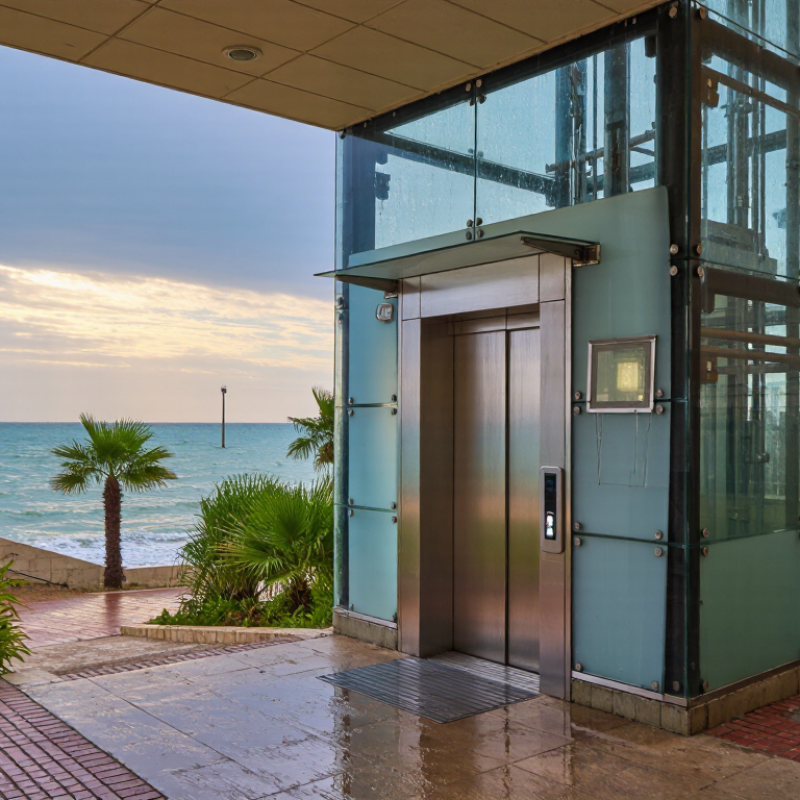
| Outdoor Weather Protection | All exposed electrical and mechanical components should be suitable for the project climate and protected against rain, dust, corrosion, and ultraviolet exposure. | Outdoor enclosures may be specified at IP54 or higher, but the exact rating must be verified for each component and installation zone. | IP test information, enclosure material specification, drainage design, coating system, and climate suitability statement. | Improves reliability in coastal, humid, dusty, snowy, and high-rainfall environments. |
| Corrosion Resistance | The supplier should offer material and coating options based on exposure category, especially for marine or industrial locations. | Common options include galvanized steel, powder-coated steel, stainless steel, and marine-grade fasteners where required. | Material certificates, coating specifications, fastener grade, and corrosion-maintenance schedule. | Controls long-term maintenance costs and protects structural components from premature deterioration. |
| Wind and Structural Design | Supplier must provide design loads and coordinate foundations, anchorage, tower stability, and local structural engineering. | Wind resistance is project-specific and depends on height, geographic wind zone, exposure, enclosure area, and local building rules. | Structural calculations, anchorage details, wind-load assumptions, and engineer-approved foundation drawings. | Avoids unsafe installations and unexpected civil-work costs during permitting or construction. |
| Safety and Emergency Features | Look for emergency lowering, door interlocks, overspeed protection where applicable, obstruction sensing, alarm, communication, and manual release procedures. | Features vary by system type and jurisdiction; passenger elevators generally require more extensive protection than basic platform lifts. | Risk assessment, safety-circuit diagram, emergency-rescue procedure, and inspection records. | Protects passengers and gives building operators a defined response to power failure or entrapment. |
| Standards and Certification | Compliance must match the installation country and lift category rather than relying only on a general quality certificate. | Relevant frameworks may include EN 81-20/50, EN 81-41, ASME A18.1, ISO 9386-1, and applicable local accessibility and electrical rules. | Declaration of conformity, type-test reports, certification scope, quality-management certificate, and local approval pathway. | Supports legal operation, project approval, insurance acceptance, and cross-border procurement. |
| Accessibility and Usability | Confirm clear door width, platform size, handrails, controls, landing levels, tactile markings, audible signals, and wheelchair turning requirements. | A wheelchair-accessible platform commonly requires clear dimensions suitable for the intended chair and local accessibility rules; dimensions must be verified in the final layout. | Accessibility drawings, door-clear-opening dimensions, control-panel details, and user manual. | Ensures the equipment works for the actual users rather than only meeting a nominal load rating. |
| Drive and Energy Consumption | Compare hydraulic, traction, screw, and electric drive systems using duty cycle, standby consumption, noise, maintenance, and local service availability. | Electric systems may reduce standby energy; hydraulic systems can provide strong lifting force but require fluid and equipment-room considerations. | Power demand, standby consumption, duty-cycle rating, noise data, and maintenance requirements. | Makes lifecycle cost comparisons more accurate than comparing purchase price alone. |
| Customization and Site Integration | Supplier should support landing orientation, shaft or tower configuration, door types, finishes, glazing, drainage, lighting, and building interfaces. | Common customization areas include platform dimensions, access sides, enclosure panels, landing gates, call stations, and finish options. | Approved shop drawings, interface schedule, finish samples, BIM or CAD files, and installation method statement. | Reduces conflicts with façades, balconies, walkways, drainage, fire routes, and existing structures. |
| Installation and Commissioning | Supplier should define whether installation, testing, statutory inspection, and operator training are included. | Factory supply lead times are often about 8–16 weeks after approved drawings, while civil works and permitting can extend the overall schedule. | Project schedule, installation scope, commissioning checklist, inspection plan, and training agenda. | Clarifies responsibility and reduces delays caused by missing site preparation or incomplete handover. |
| Warranty and Spare Parts | Prefer clearly stated coverage for equipment, controls, corrosion-related exclusions, labor, travel, and replacement parts. | A 12–24 month equipment warranty is a common commercial benchmark; coverage and exclusions differ significantly by contract. | Warranty terms, spare-parts list, parts availability statement, service contacts, and response-time commitment. | Protects buyers from high downtime and difficult parts sourcing after installation. |
| Maintenance and Remote Support | Evaluate preventive-maintenance intervals, fault diagnostics, remote monitoring, local technicians, and emergency support coverage. | Inspection and maintenance frequency depends on lift type, usage, local law, and manufacturer instructions; many commercial systems require scheduled service several times per year. | Maintenance manual, service-level agreement, diagnostic capabilities, technician qualifications, and escalation process. | Improves uptime and provides a measurable basis for comparing long-term supplier support. |
| Total Cost of Ownership | Compare equipment, shipping, duties, foundations, electrical works, permits, installation, inspections, energy, maintenance, and replacement parts. | The lowest purchase quotation may not provide the lowest lifecycle cost when civil works, climate protection, service travel, and downtime are included. | Itemized quotation, delivery terms, exclusions, five- to ten-year maintenance estimate, and lifecycle assumptions. | Creates a fair comparison between international suppliers and helps prevent hidden project costs. |